While South Africa’s historic categorisation of Gender-Based Violence and Femicide as a national disaster has intensified the spotlight on the country’s appalling statistics of violence against women and girls, the perpetrators remain mostly unmentioned. A society that cannot speak about its male perpetrators can never understand its female victims and survivors.
On 21 November 2025, South Africa formally declared Gender-Based Violence and Femicide (GBVF) a national disaster. Signalling two things at once, the news struck a dissonant chord for me—as a landmark victory for survivors and campaigners, but also as a devastating indictment of the appalling treatment of women and girls in our country.
South Africa is no stranger to national disasters, but they have so far typically resulted from extreme weather events, like drought, storms, and floods. Most recently, in June 2025, the country declared a national disaster when more than 100 people were killed and more than 4,000 displaced because of heavy rain and catastrophic floods in the Eastern Cape province. The death toll and damage were devastating, and the state’s disaster-response measures kicked in, delivering food, shelter, and medical supplies to the region, along with presidential visits to the worst affected areas. The recent news that GBVF has been declared a national disaster had a visceral effect on me precisely because it requires an upscaling of one’s response, compelling us to see this societal scourge through the lens with which we typically view “acts of God,” except that these are acts of men.
If you’re inclined to agree, that would indicate a sympathetic audience familiar with the issues. But there is a striking difference at work between media coverage of natural national disasters and coverage I have so far read of South Africa’s unprecedented GBVF national disaster. This difference is perhaps best illustrated by way of an example: the careful omission of words, the slippery linguistic trick with which I tiptoed around the perpetrators of GBVF in the second sentence of this piece. As an attuned reader, did “the appalling treatment of women and girls in our country” strike you as (male) authorial absolution, or did you not spot it because it is a typical example of how effectively the dominant patriarchal discourse has schooled us to look away from male perpetrators of violence against women? Such patriarchal training asks us, if not to condone, then at least to “understand” misogyny, to blame the victim instead, to point to the crisis in the male breadwinner mentality, and to accommodate the fallout by saying “boys will be boys, and men will be men”?
When I read the news of the declaration, I started privately counting the names of women I know who have experienced physical and sexual violence at the hands of men. It is a conservative count with strict boundaries: they can only be in South Africa, and I must know them either personally or professionally by name. So far, my count has reached 16: women who to me are sisters, cousins, aunts, grandmothers, friends, neighbours, teachers, lecturers, and colleagues.
Looking back, I was aware of some of this abuse from a very early age, but I did not know it as abuse because that is not how it was spoken about at the time. Instead, it was normalised and dismissed with comments like: Hy’t haar alweer goed gedonner. (He beat her good again.) In an English-speaking community like mine, the switch to Afrikaans—a language mostly reserved for banter and expletives—subtly and subconsciously disconnected the topic from familiarity, seriousness, and intimacy, thereby relegating it to the margins of experience and discussion with a quick linguistic flip. What strikes me while translating it today are the adjective “good” and the adverb “again”. And with that, another name comes to mind, bringing my private count to 17.
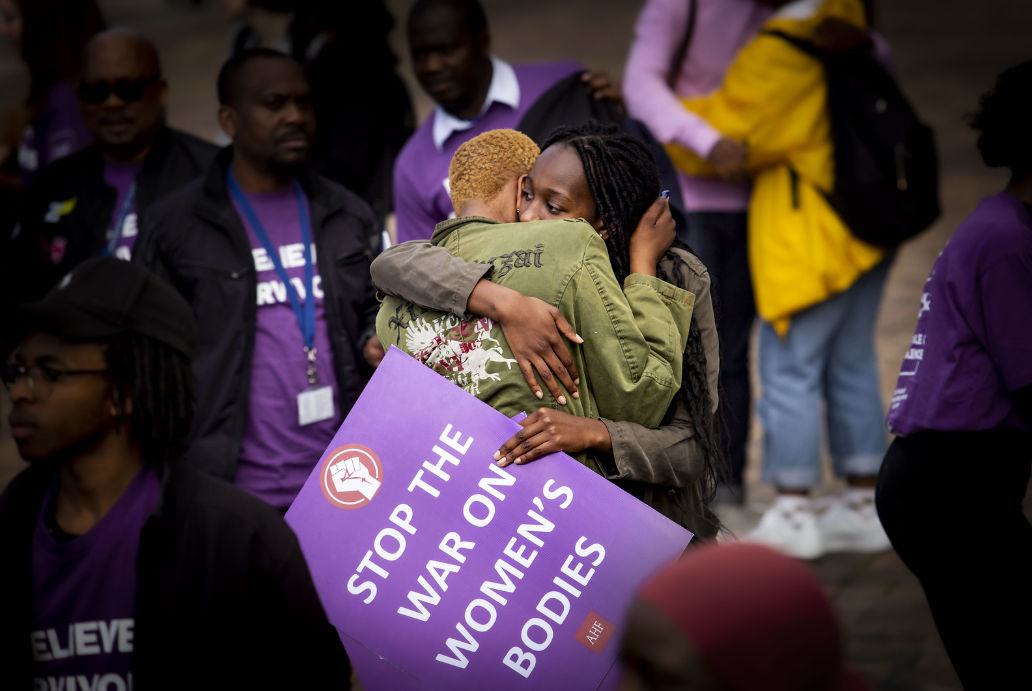
As I study the poignant photographs of the phenomenal countrywide G20 Women’s Shutdown, timed in salient synchronicity with the G20 South Africa Summit, I see the recurring slogans on many of the posters: Enough is enough. Don’t look away. Silence is violence. These slogans have meaning, but they are not enough. Of the 17 female survivors I have counted, only four have sought legal recourse. That’s about 23 percent, prompting the question: What social structures prevented the other 14 women from doing the same?
In the case of my own testimony, I have repeatedly acknowledged that it would have been harder to write had my mother been alive at the time. A few fellow survivors have communicated the same barriers to disclosure: Not while my parents are still around. Not while my mother is still alive. In extended patriarchal family structures in which acquiescence is assumed, silence demonstrates allegiance, silence shields us from what people will say, silence manifests loyalty to the family name. In such controlling contexts where women know their place and children are seen, not heard, enough is never enough; only more is more. In such households, survivors learn very early on to internalise the violence of silence because speaking up is held in contempt.
Also striking about many of the images from the Shutdown protest is the relative absence of the perpetrating gender: men. While some are present, most participants are women, returning me to my second sentence above, of which a more honest and complete revision would read: a devastating indictment of the appalling treatment of women and girls in our country at the hands of men. But how does this extended version sound, even to this sympathetic readership? Perhaps it comes across as too confrontational, or too aggressive. If so, why, when the issue under discussion is aggression of the most extreme kind?
In reality, the passive case is widely used in the coverage of sex abuse and GBVF, even by sympathetic campaigning agencies themselves. Consider this South African parliamentary media statement: “295 000 individuals experienced assault in the last year and 23% of these assaults happened inside the home. Sexual offences remain persistently high, with thousands of women and children victimised every year.” BBC coverage is as opaque regarding the perpetrators: “South Africa experiences some of the world’s highest levels of gender-based violence (GBV), with the rate at which women are killed five times higher than the global average, according to UN Women.” In this instance, the passive is especially striking because the authors are all women.
The same passive elision is evident in the summary by Women for Change, the organisation that planned the spectacular G20 Women’s Shutdown:
While the numbers are chilling, the way in which they are reported raises a question repeatedly: By whom? We cannot rise to the slogans if we cannot countenance the answer. While the numbers seek to educate, they also eclipse. For Indiran Govender from Pretoria’s Sefako Makgatho Health Sciences University, such media coverage perpetuates the problem. “Media, in reporting incidences of GBV, focus on the victim by publishing headlines that read ‘a woman has been raped’ rather than stating ‘a man has raped a woman’”. A society that cannot speak about male perpetrators can never, despite its best efforts, understand female victims and survivors.
I concede; this is a difficult question to answer, not just for South Africa, but for all male-dominated societies across Africa and around the world with rigid gender roles and deeply entrenched norms about masculinity and what it means to be a “real man”. In such social structures, it is a difficult question to ask because the typical answers are sons, brothers, brothers-in-law, male cousins, fathers, fathers-in-law, grandfathers, male fiancés, husbands, male colleagues, male community and religious leaders, and male employers. For each survivor, there is at least one perpetrator, and he is usually male, although female abusers also operate. Zooming out to include a country like the USA, which did not attend the historic G20 South Africa Summit, and where the president has a history of calling women pigs, is a sobering reminder that misogyny is not only a South African plague, but a global one.
This is also a difficult conversation for societies to have because it points to a pandemic inside a pandemic, a taboo inside a taboo. My work in suicide prevention has taught me how difficult it is for people, men, families, communities, and societies to talk about mental health in men. While the survivor-specific details of such work are confidential, the patterns are global. Africa demonstrates alarming mental health issues in men. Suicide rates in Africa are the highest in the world. The highest rates of suicide are in South Africa’s close neighbour, Lesotho. Male suicide in Africa have reached record levels; at 18 per 100,000, it is significantly higher than the global average of 12.4 per 100,000. South African men also struggle with disproportionately high mental health challenges, resulting in mental health related deaths. Of the 13,774 deaths related to mental health in South Africa in 2019, the vast majority, approximately 79%, or 10,861, were men.
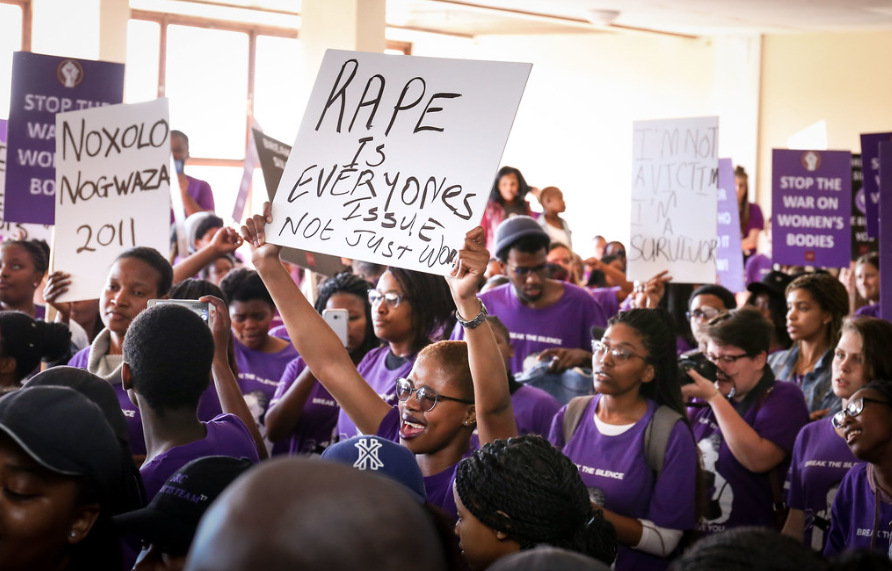
South Africa Silent Protest, 2019. Image via AHF Flickr CC
And when it comes to authorship, who is mostly doing the writing about GBV? Even in safe and inclusive spaces, a search for the acronym often reveals an authorship of mostly women. That has to change. This is not only a women’s issue. GBVF will not be fully addressed so long as men exempt themselves—or are exempted from—the conversation. Men must be engaged. Femicide rates in South Africa are akin to countries experiencing armed conflict. To put it in military terms, social norms and structures have allowed South African males to weaponise their gender against women, mostly with impunity. Men in South Africa have declared gender-based war; they must be called upon to make gender-based peace. Researchers have highlighted three ways in which this can be done: intervention in early childhood, collaborative responses, and changing harmful gender norms.
We must teach our boys differently from the outset. To be effective, these lessons cannot only be taught by women and mothers; they must also be taught by men and fathers. The same applies to authorship, which is why I feel compelled to contribute to the topic. While I do not claim to speak for all men, as a South African man who is also from the LGBTQI+ community, and as a survivor, I can use the 16 Days of Activism to add my name, and to stand with other survivors and their families, especially as my private count has now reached 24, including men abused by women. With total recall, my count may increase over the coming days, but hopefully, with these new national disaster measures, those survivors will feel safer, and there will be no new names to add to my list.

 Unwritten Lives uses only essential cookies required for basic functionality.
We do not use analytics, tracking, or advertising cookies.
Unwritten Lives uses only essential cookies required for basic functionality.
We do not use analytics, tracking, or advertising cookies.